
Blog Incentive Program Design Incentive Technology Incentive Trends
Don’t Wait for April: How March Behavior Shapes Your Next Quarter
 One10
|
March 5, 2026
One10
|
March 5, 2026

Why March Sales Behavior Determines Q2 Performance
March doesn’t end the quarter.
It engineers the next one.
For sales leaders, the final 30 days of Q1 are not just about closing revenue. They are about reinforcing the behaviors that will define Q2 stability, confidence, and pipeline strength.
When March becomes “close at all costs,” Q2 often becomes “recover at all costs.”
At One10, we see this pattern repeatedly across enterprise sales teams: The behaviors leaders reinforce under pressure compound into the next quarter—either positively or destructively.
What Changes in Sales Teams During March?
March introduces compression.
Time shrinks.
Forecast scrutiny increases.
Leadership visibility rises.
From a Motivation Science perspective, compressed timelines alter behavior in predictable ways:
- People prioritize short-term certainty over long-term stability.
- Cognitive bandwidth narrows under pressure.
- Risk tolerance decreases.
This means that without intentional leadership design, teams default to:
- Chasing late-stage deals at any cost
- Discounting to reduce uncertainty
- Reducing prospecting because it doesn’t impact this quarter
These responses feel rational in the moment.
They are biologically predictable.
But they create instability in Q2.
Why “Close at All Costs” Hurts Next Quarter
1. Pipeline Starvation
When prospecting activity drops in March:
- April looks stable.
- May feels thin.
- June feels fragile.
- Behavioral reinforcement matters.
If only closed revenue is celebrated in March, early-stage behaviors weaken.
And pipeline gaps always appear 60–90 days later.
2. Discount Dependency
When pressure increases, discounting increases.
While discounting may help secure revenue in the moment, it:
- Erodes margin
- Lowers perceived value
- Signals urgency to buyers
- Undermines rep confidence long term
Behavior reinforced under pressure becomes normalized. If discounting becomes the “winning behavior” in March, it becomes habit in Q2.
3. Recognition Collapse
In many organizations, recognition narrows in March.
Only closed deals are acknowledged.
Effort without immediate revenue goes unseen.
This quietly demotivates the middle of the team—the performers who build long-term pipeline health.
At One10, we refer to this as reinforcement imbalance.
When only outcome metrics are rewarded, behavior-level engagement drops.
What Should Sales Leaders Focus on in March?
The highest-performing sales organizations use March differently.
They close hard—but they protect behavioral integrity.
Here’s what that looks like.
1. Protect Leading Indicators While Pushing Results
Elite leaders track both:
- Closed revenue
- Leading behaviors (meetings, stage progression, qualified opportunities)
They do not allow prospecting to disappear simply because it does not impact Q1 revenue.
Motivation Science principle: What gets reinforced gets repeated.
If prospecting disappears from dashboards and recognition in March, it disappears from behavior in April.
2. Fuel Leading Behaviors with Immediate Rewards
Behavioral science shows that immediate rewards are powerful motivators.
Quick, tangible recognition matters. Think: a $5 coffee gift card for booking a meeting, or a shout-out in a team chat for advancing a deal stage.
These moments trigger a small dopamine boost. Reps want to repeat those behaviors.
These “micro-incentives” keep energy high. Even as quarter-end pressure mounts.
Small, frequent rewards or recognition make a difference. This ensures prospecting and other leading indicators don’t get ignored in the rush to close deals.
These small moments keep your whole team energized throughout March. They lay the foundation for a successful Q2.
3. Redefine “Winning” for the Final 30 Days
Instead of communicating:
“Hit the number at any cost.”
Elite leaders communicate:
“We close strong and build smart.”
They:
- Recognize disciplined execution
- Celebrate both closed revenue and pipeline creation
- Reinforce clean forecasting and stage movement
This protects both performance and culture.
4. Coach for Q2 While Leading Q1
March provides a unique diagnostic window.
Leaders should ask:
- Which behaviors are slipping under pressure?
- Which reps are protecting pipeline vs building it?
- Are we reinforcing fear—or confidence?
This is where leadership maturity shows.
January reveals ambition.
February tests discipline.
March reveals consistency under pressure.
How to Finish Q1 Without Sacrificing Q2
The March Discipline Framework
To protect next quarter while closing this one:
- Close with focus.
- Protect early-stage activity.
- Reinforce behavior—not just revenue.
- Maintain stable incentives.
- Communicate confidence, not panic.
This framework ensures that performance compounds instead of collapses.
Is It Too Late to Protect Q2 in March?
No.
March is the final opportunity to influence behavioral patterns before they solidify into Q2 norms.
April does not reset culture.
It reflects March behavior.
Sales leaders who succeed long term understand this:
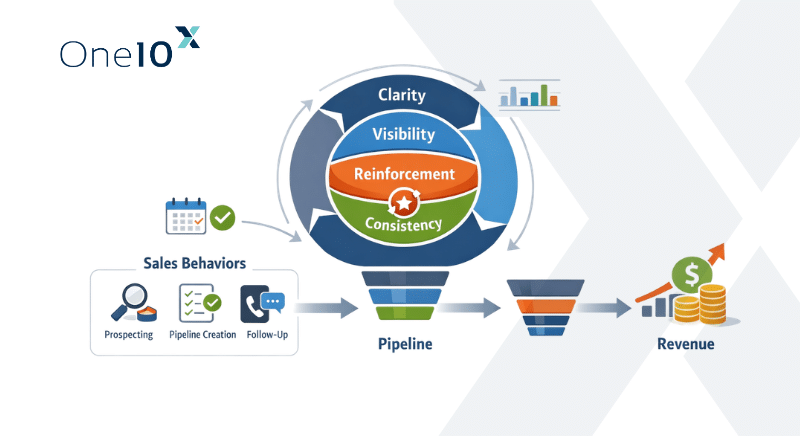
- Revenue is an outcome.
- Behavior is the lever.
- Reinforcement is the accelerator.
At One10, our Motivation Science framework is built on this principle: Design the right behaviors under pressure—and performance sustains itself beyond the quarter.
Frequently Asked Questions
Why does Q2 sometimes start slow after a strong Q1?
Because Q1 often ends with reduced prospecting and overemphasis on late-stage deals, creating a pipeline gap that appears 60–90 days later.
What should sales leaders prioritize in March?
Leaders should prioritize leading indicators, behavior reinforcement and incentive stability while continuing to close revenue.
How do you close a quarter without hurting the next one?
By reinforcing both closed deals and pipeline creation, maintaining consistent incentives and avoiding panic-driven changes.
Should sales leaders change compensation plans in March?
No. Mid-quarter compensation changes increase anxiety and reduce trust. Adjust execution focus instead.
The Bottom Line
March is not the end of Q1.
It is the foundation of Q2.
The behaviors you tolerate.
The incentives you reinforce.
The tone you set.
They compound.
Elite sales leaders do not wait for April to fix next quarter.
They design it—intentionally—through disciplined March behavior.
Request a Sales Behavior Diagnostic today!